
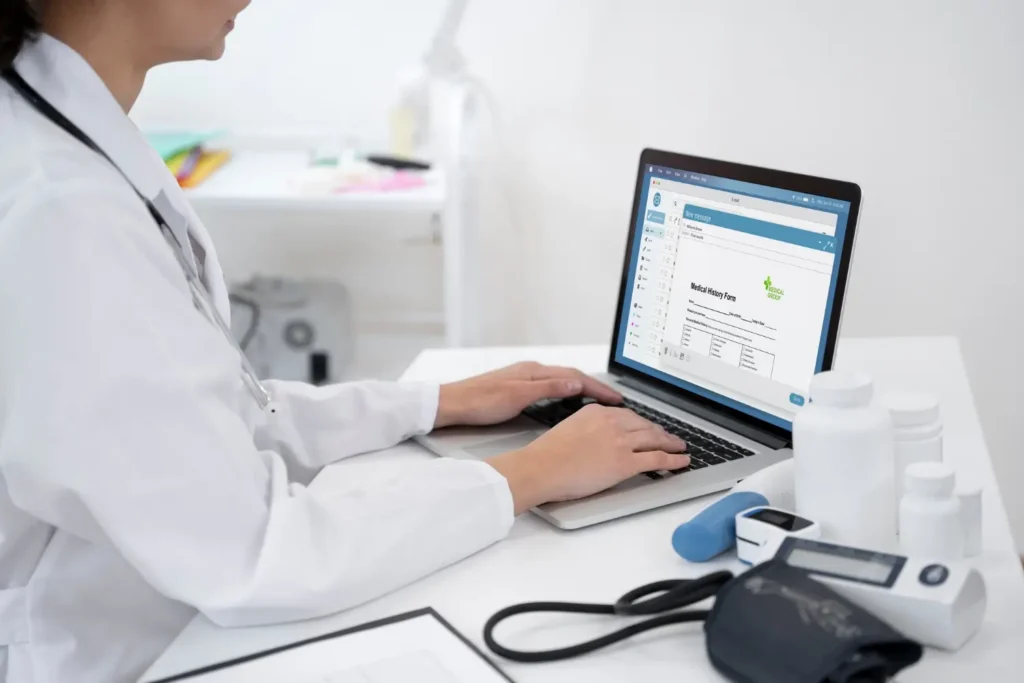
Why accreditation matters for online medical billing and coding education?
Accreditation is an external quality-review process. It can help students evaluate whether a college or a specific academic program has been reviewed against published standards. It may also matter for federal student-aid participation, transfer planning, eligibility for certain professional credentials, or further study.
However, the phrase “accredited medical billing and coding certification” is often used loosely in advertisements. A training provider may be institutionally accredited, while the individual course is not separately programmatically accredited. A college may offer a CAHIIM-accredited HIM degree and a separate noncredit medical coding class that is not included in that program’s accreditation. A professional certification body may offer exam preparation, but that does not mean it accredits the school delivering the course.
For a student, the practical question is not just “Is this school accredited?” It is:
- Which legal institution will enroll me and issue the award?
- Which accrediting organization reviewed the institution or the exact program?
- Is the program listed in the accreditor’s current directory, and what is its status?
- Does the delivery format match the online study arrangement being advertised?
- Does the program meet the education or experience requirements for the professional credential I want?
- Is the exact program eligible for federal or state financial aid, if I plan to use it?
Accreditation is a useful verification tool, not a guarantee of employment, exam success, transfer credit or a particular salary.
Important: There is no single accreditation that applies to every medical billing and coding course or professional certification. Institutional accreditation, CAHIIM programmatic accreditation, and AAPC/AHIMA/NHA professional certification are different things. The examples below are verifiable academic programs related to health information management (HIM); they are not all short medical-coding certificates or direct CPC/CCS exam-preparation courses.
Accrediting bodies: what each one actually verifies
1. U.S. Department of Education-recognized institutional accreditors
Institutional accreditation evaluates a college or institution. The U.S. Department of Education publishes a current list of institutional accrediting agencies recognized by the Secretary. Its page explains that, unless a specific Title IV limitation is shown, accreditation by an agency on the list may be used by an institution to establish eligibility to participate in federal student-aid programs.
This is relevant when you are considering a college certificate or degree. Check the institution’s legal name in the Department’s Database of Accredited Postsecondary Institutions and Programs (DAPIP), then confirm the accreditor and current status. Do not rely only on an accreditation logo in an advertisement.
Institutional accreditation does not mean every course at the college has separate programmatic accreditation. It also does not mean every noncredit course or short training product qualifies for federal student aid.
2. CAHIIM: programmatic accreditation for health information education
The Commission on Accreditation for Health Informatics and Information Management Education (CAHIIM) accredits specific academic programs in health information management and related health information disciplines. Its directory includes degree and certificate programs, and lets prospective students search by institution, program level, subject area and delivery method, including online.
CAHIIM is particularly important for students considering a formal HIM education pathway. AHIMA’s current RHIT eligibility guidance requires candidates to complete the academic requirements, at the associate-degree level, of a CAHIIM-accredited Health Information Management program, or to meet an accepted foreign-equivalency route. AHIMA also states that a general health informatics program is not currently accepted for RHIT eligibility.
Do not assume CAHIIM accredits every medical billing course, every CPC preparation class or every certificate a college sells. Search the exact program title and confirm the subject area, award level, delivery format, enrollment status and current accreditation award.
3. Professional certification organizations: AAPC, AHIMA and NHA
AAPC, AHIMA and the National Healthcareer Association (NHA) award professional credentials such as CPC, CCS, RHIT and CBCS. These credentials are not the same as institutional or programmatic accreditation.
A training course may prepare you for an exam, document study hours, or provide practice cases. The professional organization still controls its own eligibility rules, examination, credential award and maintenance requirements. For example, completing a CPC preparation course does not itself make someone a CPC; the candidate must pass AAPC’s exam and meet applicable requirements.
4. How to interpret “accredited online program” claims
When a provider says “accredited,” ask whether it means:
- The institution has institutional accreditation from a Department-recognized agency.
- The exact HIM academic program has CAHIIM accreditation.
- A career school has institutional accreditation from another recognized accreditor.
- The course is simply approved by the provider, an employer, or a certification-preparation organization.
Each may describe a different kind of review or relationship. Ask for the actual directory record and scope rather than relying on the adjective alone.
Online accredited program examples to compare
The programs below are examples found in CAHIIM’s current program directory. They are Health Information Management associate-degree programs, not a ranked list of standalone CPC certificates. Their directory records identify online delivery and an active enrollment status. Program costs, admission requirements, practicum arrangements and available aid differ, so obtain a written estimate from each institution before applying.
| Institution / program | Delivery and level in CAHIIM directory | Accreditation status shown | Important point to verify |
|---|---|---|---|
| DeVry University – Online Associate, Health Information Management | Online; associate degree | Active; continuing accreditation; February 9, 2026 accreditation date; next review cycle 2033–2034 | Confirm the exact Health Information Track and degree requirements. DeVry identifies its online Associate of Applied Science in Health Information Technology with the Health Information Track as CAHIIM-accredited. |
| Portland Community College – Health Information Management | Online; associate degree | Active; continuing accreditation; February 9, 2026 accreditation date; next review cycle 2033–2034 | PCC says its HIM program is online except for the practicum, which may be in person. Its separate noncredit Medical Coding training is a different offering. |
| Meridian Community College – Health Information Technology | Online; associate degree | Active; continuing accreditation; June 25, 2026 accreditation date; next review cycle 2033–2034 | Confirm the current online course sequence, admission requirements and any supervised professional-practice requirements. |
| Minnesota State Community and Technical College – Health Information Management | Online; associate degree | Active; continuing accreditation; February 9, 2026 accreditation date; next review cycle 2033–2034 | Confirm course availability, transfer-credit rules, residency requirements and total cost for your intended start term. |
| Stark State College – Health Information Management | Campus-based and online; associate degree | Active; continuing accreditation; November 3, 2026 accreditation date; next review cycle 2033–2034 | Ask which courses and practical requirements can be completed remotely and whether any campus visits are required. |
These are examples, not endorsements or a complete list. CAHIIM’s live directory can change as programs receive new accreditation actions, modify delivery formats or change enrollment status. Always open the individual program record before relying on a listing. A program’s CAHIIM status should not be assumed to establish federal aid eligibility or guarantee that every student meets RHIT eligibility; confirm those points separately.
Academic HIM degree vs. short medical coding course: a real distinction
Portland Community College provides a useful illustration. Its site describes an online Health Information Management associate degree and separately lists a noncredit Medical Coding training program of less than one year. The college says the medical coding training prepares students to pursue AAPC certification, while noting that the HIM associate program includes an online format except that the practicum may be in person.
These are two different education products at the same institution. Do not describe the noncredit training as a CAHIIM-accredited associate degree just because the college also offers a CAHIIM-accredited HIM program. Review the precise award and directory record for the product you intend to buy.
How to verify an accredited online medical billing and coding program?
Use this sequence before paying an application fee, deposit or tuition installment.
Step 1: Identify the award and institution
Write down the full legal name of the institution, the exact program title, the award (course completion, undergraduate certificate, associate degree or other credential), and the organization that will issue your transcript or certificate. Check whether the advertised online program is operated by the same legal institution.
Step 2: Search the relevant accreditation directory
For institutional accreditation, search the institution in DAPIP and check the Department’s current institutional accreditor list. For an HIM academic program, search CAHIIM by institution and exact program name. Do not rely on an old PDF or a third-party directory when the accreditor maintains a live program record.
Step 3: Confirm the current status and scope
Check whether the program is active, continuing, initial, inactive, on a progress report or subject to any published action. Read the award level and subject area. If the listing says online, confirm what that means in practice: fully asynchronous, scheduled online classes, hybrid courses, or online coursework with an in-person practicum.
Step 4: Match the program to your credential goal
If you want CPC, confirm that the curriculum prepares you for professional-fee coding and AAPC’s current exam outline; CAHIIM accreditation is not a universal CPC prerequisite. If you want RHIT, confirm that the exact program meets AHIMA’s CAHIIM-accredited HIM associate-level academic requirement. If you want CCS or CBCS, check the certifier’s own eligibility and recommended preparation rather than assuming any accredited course automatically meets them.
Step 5: Confirm federal financial-aid eligibility separately
Ask the college’s financial-aid office whether the exact program is an eligible Title IV program for the award year and whether the online delivery arrangement is covered. A school’s general statement that it accepts FAFSA does not prove every certificate, noncredit course or professional exam-preparation package is eligible.
Step 6: Request a full cost and course plan
Get tuition, required fees, books, coding software, practicum or travel costs, transfer-credit review, exam fees and expected completion time in writing. Ask whether credits apply to a later degree and request the policy or articulation agreement. A low advertised per-credit price is not enough to compare the total investment.
Red flags to investigate before enrolling
- Vague accreditation language: The provider says “fully accredited” but will not identify the institution, accreditor and exact program.
- Course-level claim unsupported by the directory: The college is accredited, but the specific medical coding course is not listed as CAHIIM-accredited.
- Confusing certificate with certification: The provider promises that course completion makes you CPC, CCS or CBCS without a separate professional exam.
- Unclear RHIT pathway: A school claims its general health informatics course qualifies for RHIT, even though AHIMA’s current RHIT rules require a CAHIIM-accredited HIM program or accepted foreign-equivalency route.
- No explanation of online practical requirements: The program is advertised as online, but the provider does not disclose campus visits, practicum placements, proctored exams or state-specific limits.
- FAFSA guarantee: An admissions representative says every program is covered by federal aid without confirming the exact program with financial aid.
- Unsubstantiated job or salary promises: The provider guarantees employment, remote work or a specific income after a short course.
- Pressure to pay immediately: The school will not provide a written fee schedule, refund policy or program description before asking for a deposit.
An unclear claim is a reason to pause and request documentation. It is not, by itself, proof of misconduct.
FAQs:
Is there an accredited online medical billing and coding certification?
There are accredited online academic programs in Health Information Management and related subjects, and there are online courses that prepare students for professional coding certifications. These are not identical. CAHIIM accredits specific HIM and related academic programs; AAPC, AHIMA and NHA award professional certifications after candidates meet their rules and pass exams. Verify which outcome a provider actually offers.
Is CAHIIM accreditation important for medical coding?
It is particularly important if you are considering an HIM academic pathway or want to meet AHIMA’s RHIT education requirement. It is not a universal prerequisite for every coding credential, such as CPC. Confirm the requirements of the specific certification organization and employer.
Does CAHIIM accredit every medical billing and coding certificate?
No. CAHIIM lists specific programs in its directory, with stated program levels, subject areas and delivery modes. Its directory includes HIM and related health information certificates, but it does not show every private medical coding course or professional exam-preparation package as accredited. Search the exact program title.
Can I earn RHIT after an online medical coding certificate?
Not automatically. AHIMA’s standard U.S. route requires completion of associate-degree-level academic requirements in a CAHIIM-accredited Health Information Management program. A short coding certificate or general health informatics course is not a substitute unless the specific academic route meets AHIMA’s current eligibility rules.
Is a CAHIIM-accredited program the same as a CPC certification course?
No. CAHIIM accredits academic programs in health information management and related fields. A CPC preparation course teaches material for AAPC’s professional exam. A student may pursue both academic study and professional certification, but the accreditation and credential are separate.
Can an accredited online program qualify for FAFSA?
Possibly, but accreditation alone does not establish Title IV eligibility for every program. The institution and exact program must meet federal requirements, and the student must meet personal eligibility criteria. Confirm the program with the school’s financial-aid office for the relevant award year.
Are online HIM programs completely online?
Not always. Some CAHIIM-listed programs are described as online but require a practicum, clinical placement, in-person assessment or other location-dependent activity. For example, Portland Community College says its HIM program is online except for the practicum, which may be in person. Ask the program to identify every in-person requirement.
Will an accredited program guarantee a medical coding job?
No. Accreditation is not a job-placement guarantee. Employers may also require professional certification, coding experience, specific code-set knowledge, software familiarity and productivity standards. Review current job postings in your target location before choosing a course.
Verify the program, then compare the credential pathway
An accredited program can be a sound foundation, but only when the accreditation applies to the exact institution or academic program you intend to attend. Start with the career outcome: physician-office coding, hospital facility coding, billing, or broader health information management. Then confirm the program’s status, study format, credential alignment and full cost.
Continue with climberguy’s medical billing and coding certification guide, compare online certification programs, review the difference between a medical coding certificate and certification, and explore accredited medical billing and coding schools.
Authoritative sources:
- CAHIIM Program Directory
- CAHIIM Certificate Programs Directory
- CAHIIM: DeVry University Online Associate HIM program
- CAHIIM: Portland Community College HIM program
- CAHIIM: Meridian Community College HIM program
- CAHIIM: Minnesota State Community and Technical College HIM program
- CAHIIM: Stark State College HIM program
- U.S. Department of Education: Institutional Accrediting Agencies
- U.S. Department of Education: DAPIP
- AHIMA: RHIT Eligibility Requirements
- AAPC: CPC Preparation Course
- Federal Student Aid Handbook 2026–2027: Institutional Eligibility
- Federal Student Aid Handbook 2026–2027: Program Eligibility and Distance Education
Key takeaways:
- Check what is accredited: the college, a specific HIM program, or a separate training course. These are not interchangeable claims.
- CAHIIM accredits specific academic programs in health information management and related fields. Its directory allows filtering by program level, subject area and online delivery.
- A CAHIIM-accredited HIM associate program can be relevant to the AHIMA RHIT pathway. AHIMA says candidates must complete the academic requirements of a CAHIIM-accredited HIM program at the associate-degree level, or meet an accepted foreign-equivalency route.
- CPC, CCS and CBCS are professional credentials awarded by their respective certification organizations after candidates meet the rules and pass the relevant exam. A college course does not automatically award these credentials.
- Current examples in CAHIIM’s directory include online HIM associate-degree programs at DeVry University, Portland Community College, Meridian Community College and Minnesota State Community and Technical College.
- Before paying, verify the exact program’s current accreditation status, delivery format, admission requirements, practicum obligations, total cost, financial-aid eligibility and professional-certification pathway.
Author and review:
Written by: climberguy Editorial Team
Review status: Source-checked against official guidance on june 14, 2026.
Last updated: October 25, 2026
Next review: January 14, 2027
This guide is for education and general information. It is not individualized financial, legal, or tax advice. See our disclaimer.
AI disclosure: AI tools may have assisted with research organization and drafting. A human editor reviewed and source-checked this page before publication.